

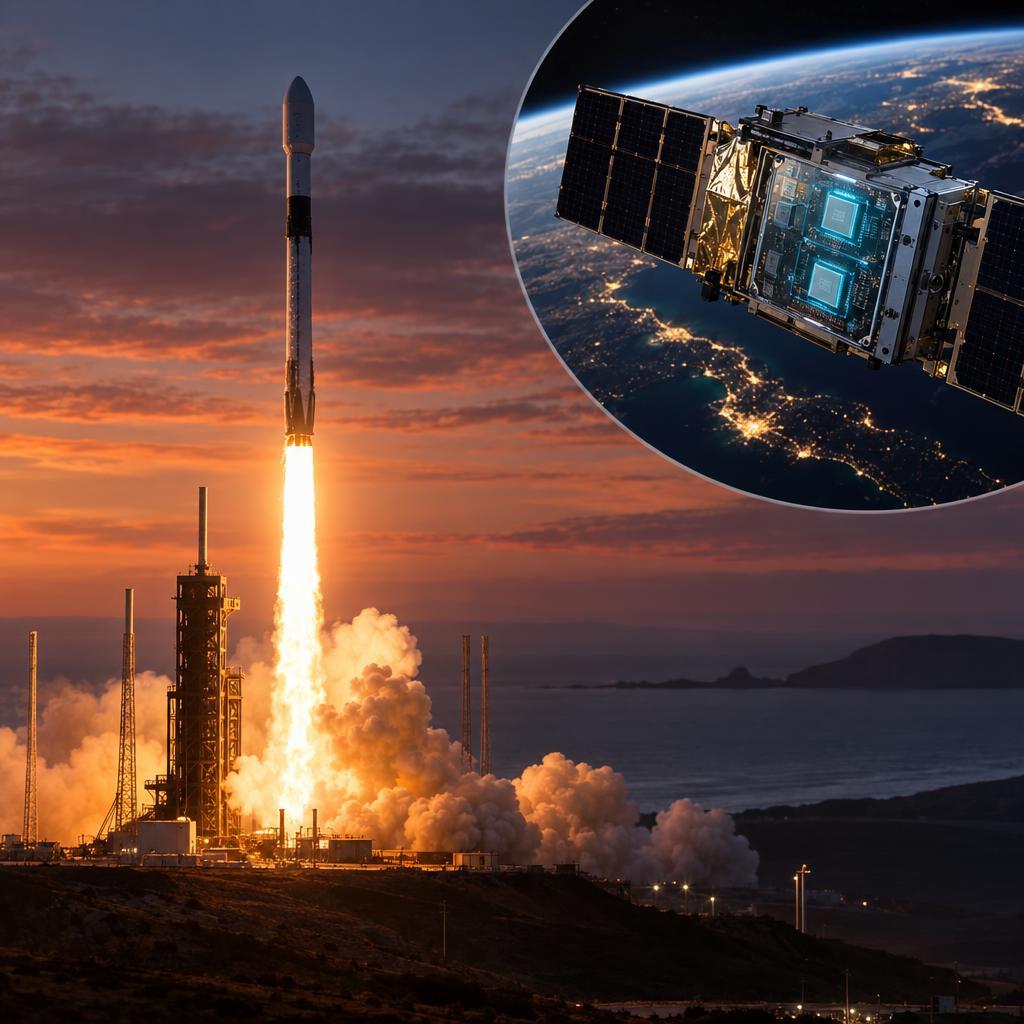
Google’s AI Chips Soar Into Space Aboard SpaceX Rocket
In a groundbreaking development for both space exploration and artificial intelligence, Google has triumphantly launched four of its bespoke Trillium Tensor Processing Units (TPUs) into orbit. This was achieved aboard a SpaceX Falcon 9 rocket, under the umbrella of the company’s ambitious Project Suncatcher initiative. The launch was executed on October 1, 2026, from Vandenberg Space Force Base in California. This was part of SpaceX’s Transporter-18 rideshare mission, which carried 130 payloads to low-Earth orbit.
The satellite, comparable in size to a refrigerator, was constructed in collaboration with Planet Labs PBC. It houses the four TPUs and is entirely powered by solar panels. The vacuum of space serves as the cooling system, replacing traditional data center infrastructure. Google confirmed contact with the satellite shortly after launch and reported it was operating as expected.
This mission signifies the first in-orbit test for Project Suncatcher. This is a “moonshot” research initiative that Google unveiled in November 2025. Its aim is to develop solar-powered AI computing infrastructure that operates continuously in space. The primary objective at this stage is to ascertain whether Google’s advanced AI chips can endure launch forces, radiation, and the extreme thermal environment of orbit.
According to Google’s own research, achieving full-scale orbital data centers by 2035 would necessitate approximately 1,800 Starship launches. This presents a staggering yet increasingly feasible logistical challenge. The company’s plans include constructing a two-satellite constellation by early 2027, with an eventual vision of 81-satellite clusters.
Source: CNBC