

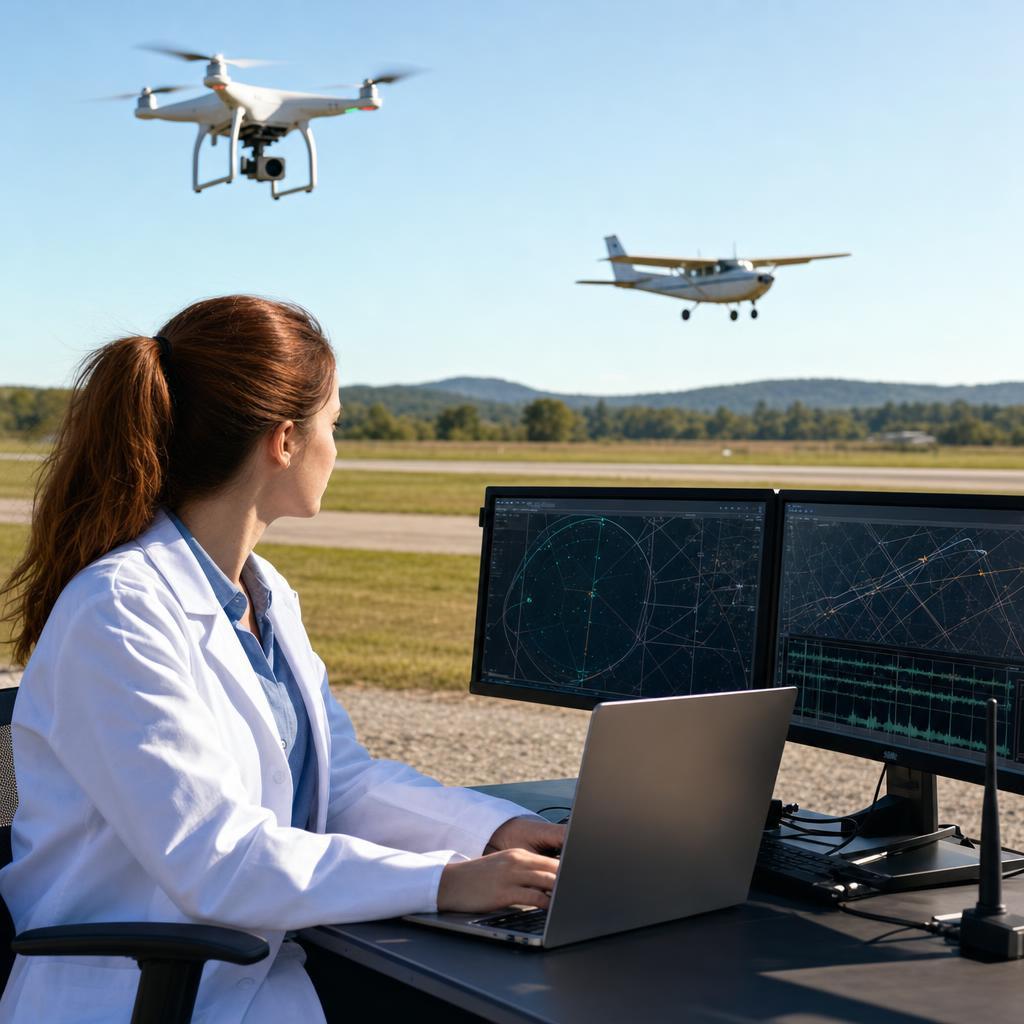
Groundbreaking AI from Georgia Tech Enables Drones to ‘Tune In’ to Small Airport Pilots
Researchers at the Georgia Institute of Technology have developed an innovative system that allows autonomous aircraft to interpret pilot radio calls at non-towered airports. This development could be a significant game-changer for the safe integration of drones into general aviation airspace.
The research, unveiled at the 2026 IEEE International Conference on Robotics and Automation (ICRA) — the largest congregation of robotics researchers globally, employs a speech-to-text model to transcribe Common Traffic Advisory Frequency (CTAF) radio transmissions. It then utilizes a modified large language model (LLM) to decipher pilot intentions and forecast flight paths.
The outcomes have been impressive: the Georgia Tech team managed to reduce the average error in trajectory predictions by over 50% — from almost one kilometer down to roughly 400 meters — in comparison to current state-of-the-art approaches. The system was validated using actual flight data and radio calls from a non-towered airport in Pennsylvania.
Non-towered airports account for nine out of ten airfields in the United States and globally. Lead researcher Sundhar Vinodh Sangeetha pointed out that as drone delivery and autonomous air mobility proliferate, these airports represent both a massive opportunity and a critical safety challenge. Besides drone integration, the technology could also function as a backup collision-warning system for human pilots.
“If you have a solution like this where you have a computer monitoring radio traffic and what aircraft are doing, you can potentially warn pilots before accidents happen,” Sangeetha said.
Source: General Aviation News – Drone Collision Avoidance: Listening to Radio Calls