

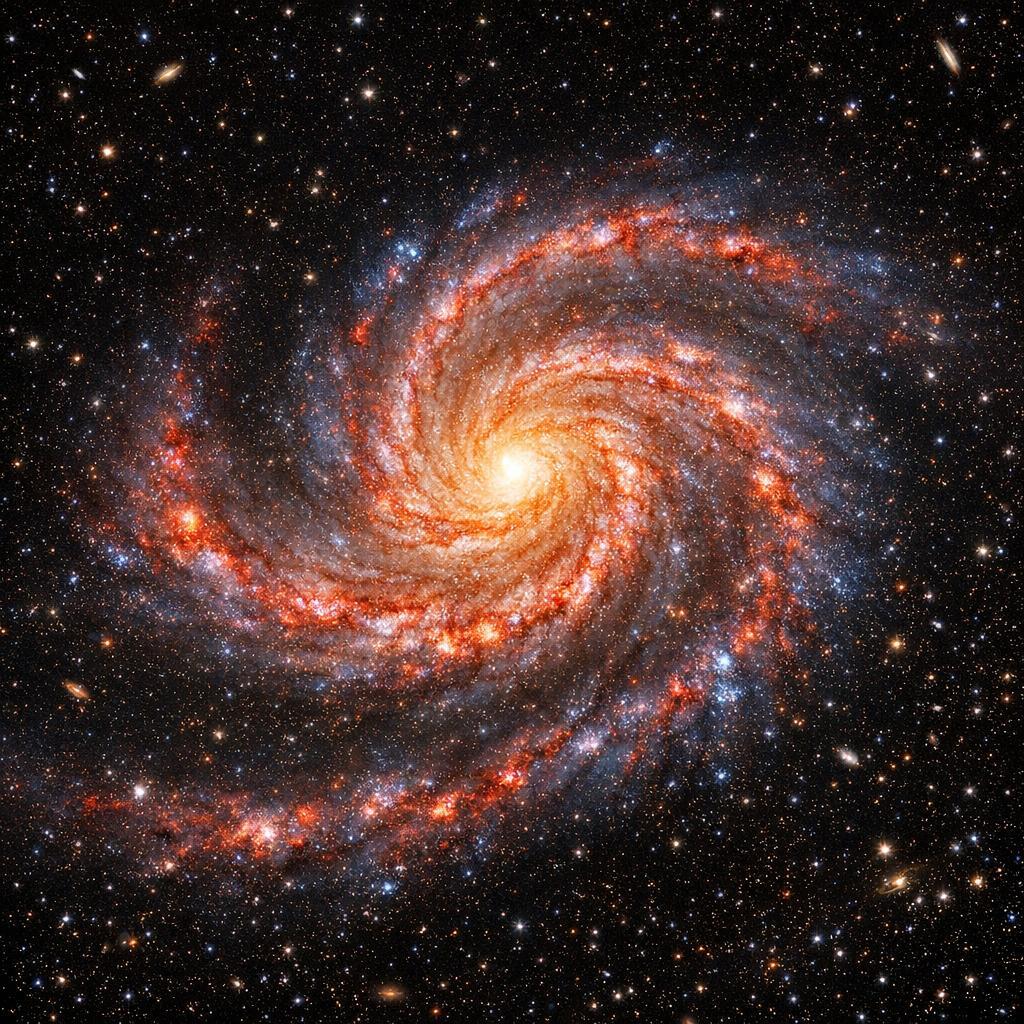
James Webb Telescope Unveils an Ancient Grand-Design Spiral Galaxy, Challenging Current Theories
Astronomers leveraging the James Webb Space Telescope have made a groundbreaking discovery. They’ve found a massive “grand-design” spiral galaxy that emerged a mere 1.5 billion years post the Big Bang. This discovery poses a significant challenge to existing theories regarding galaxy formation and evolution.
The galaxy, known as A2744-GDSp-z4, boasts two distinct spiral arms that extend from its core. It has a stellar mass of approximately 14 billion solar masses. With a redshift of 4.03, the light JWST detected was emitted over 12 billion years ago, making it one of the most distant spiral galaxies ever observed.
“Galaxies in the early universe tend to be clumpy,” as opposed to the organized structure seen in A2744-GDSp-z4. This makes the discovery especially intriguing to scientists. Grand-design spiral galaxies like this one usually form much later in cosmic history. They require billions of years of gravitational interactions and stellar evolution to develop their characteristic elegant arms.
The galaxy spans roughly 32,000 light-years in diameter and is forming stars at a rate of 57.6 solar masses per year. Despite its active star formation, this rate is relatively modest compared to other galaxies of its size and age.
Indian astronomers who reported the discovery pointed out that very few grand-design spiral galaxies have been found with a redshift above 3.0. This corresponds to light that has been traveling for nearly 11.5 billion years. The newly discovered galaxy pushes this boundary even further back in time.
This unexpected finding could compel scientists to rethink how quickly large, organized galactic structures can form in the early universe. The discovery was made as part of observations of the Abell 2744 galaxy cluster field, with results published in December 2024.
Source: Phys.org